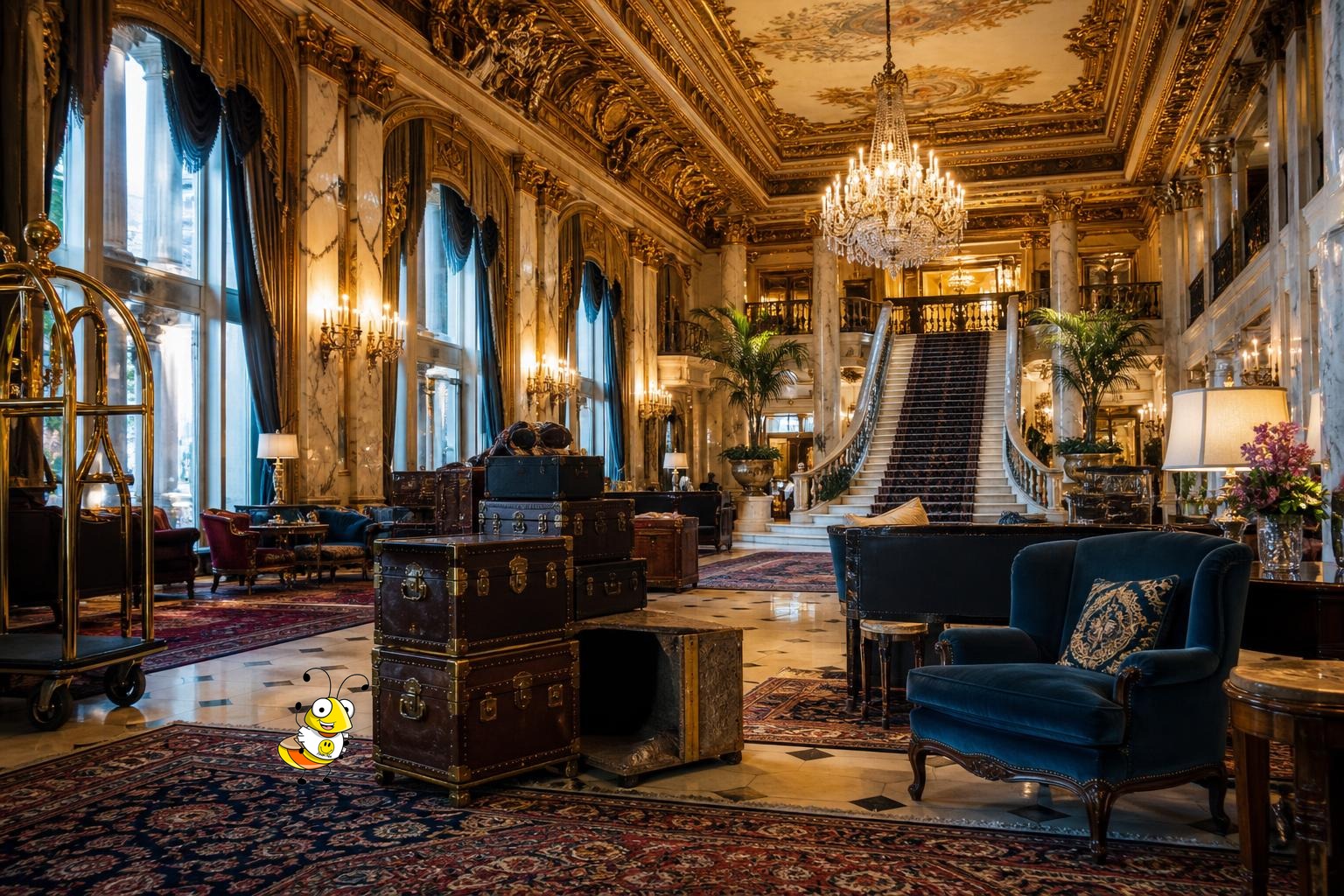
Many travelers book luxury stays at retail, paying a markup on the same hotel rooms, resort suites, and cruise cabins that wholesale buyers access at dramatically lower prices. The gap between what a 5-star property costs at net wholesale and what it costs on Expedia or Booking.com is not a rounding error. HappiTravel’s typical hotel savings run 60–80% off the retail price. That gap is why luxury travel feels out of reach for most people. It is not because luxury inventory is inherently unaffordable. It is because the retail pricing layer makes it appear that way.
The Luxury Markup Is the Largest Markup in Travel
Every hotel room moves through a distribution chain. The property sets a net wholesale rate — the base price it will accept to fill the room. Wholesale distributors, online travel agencies, and retail platforms each add margin before the room reaches a consumer’s screen. On a $90 mid-tier hotel room, that margin might add $30–$50. Annoying, but survivable.
On a $400 luxury suite, the same percentage markup adds $150–$250 per night. Over a five-night stay, a traveler paying retail on a high-end property can lose $750–$1,250 to margin alone — money that buys nothing additional. The room is the same room. The view is the same view. The thread count does not change based on which website processed the reservation.
This is the central irony of luxury travel pricing: the more premium the experience, the more a consumer overpays in absolute dollars when booking at retail. The markup scales with the room rate, which means luxury travelers — the segment that can theoretically afford to be least price-sensitive — are the segment most penalized by the retail distribution model.
Why Luxury Inventory Is Available at Wholesale
There is a persistent misconception that high-end properties do not release wholesale inventory. The opposite is true. Luxury hotels and resorts have the strongest economic incentive to distribute through wholesale channels.
A 200-room luxury resort with an average nightly rate of $500 faces a simple math problem every night: an unsold room generates exactly $0 in revenue and cannot be sold tomorrow. But a guest paying a lower wholesale rate still spends on dining, spa services, poolside drinks, and incidentals — categories where luxury properties carry their highest profit margins. A guest who booked at $250 wholesale and spends $150 at the resort restaurant is more valuable than an empty room priced at $500 that no one booked.
This is why hotels typically set aside 30–40% of their rooms at wholesale, and luxury properties have the same incentive. They would rather fill rooms at thinner margins and capture ancillary revenue than hold out for full retail and risk vacancy. The wholesale inventory exists. The question is whether a consumer can reach it.
The Access Problem — and How It Disappeared
Historically, wholesale luxury rates were visible only to travel industry professionals — agents with consortia memberships, tour operators with volume agreements, and the OTAs themselves, which bought wholesale and sold retail. A consumer searching for a beachfront suite in Cancún or a 5-star week on the Spanish coast saw only the retail price. The net rate underneath it was invisible.
HappiTravel’s wholesale travel membership removes that barrier. With direct commercial agreements across 200+ wholesale suppliers — and the transaction volume to qualify for the same net-rate tier that Expedia and Booking Holdings receive — HappiTravel surfaces the underlying wholesale price on every search. That includes luxury inventory.
The platform’s Hotels engine covers 2.5 million+ properties worldwide, as of early 2026, and the default sort ranks results by largest percentage savings first. When a member searches a luxury destination, the properties with the deepest wholesale discounts surface at the top. The HappiPrice® displayed is the net rate — not a retail price with a coupon applied, not a “member discount” shaved off an inflated anchor. It is the actual wholesale rate the supplier set before any markup was added.
What Luxury at Wholesale Actually Looked Like
The numbers tell the story more clearly than any positioning statement. The examples below are illustrative — drawn from wholesale searches and one member’s actual booking, captured in early 2026. They are not live, real-time pricing; wholesale rates on any given property move with date, season, and availability the same way retail prices do, so a search today may not return the exact figures below.
In a search for a 4-star hotel in Las Vegas, a property that retailed at $42 per night on a major OTA appeared on HappiTravel at $10 per night for the same dates — a 77% reduction, with an identical room, amenities, and location regardless of booking channel.
In a search for a 5-star resort on the Spanish coast, seven nights at retail priced out to $990. The same week through HappiTravel came in at $396 — 60% savings on a property most travelers would consider aspirational.
One HappiTravel member’s actual booking illustrates the pattern at the high end: an 11-night Eastern Caribbean cruise in a Veranda Suite. Retail on the cruise line’s own website: $15,015.46. The member’s wholesale price through HappiTravel, including port charges and taxes: $5,647.46. Total savings on that single booking: $9,368.
These are real searches and a real booking, not theoretical projections — and together they illustrate a pattern that holds across luxury inventory generally: the higher the retail price, the larger the absolute dollar savings tends to be at wholesale.
The Resorts Engine — Pre-Purchased Luxury at Scale
Beyond its 200+ live wholesale data feeds, HappiTravel also carries an inventory model that most consumers have never encountered: pre-purchased resort weeks.
HappiTravel also secures large blocks of pre-purchased inventory at top resorts worldwide. This is not a negotiated discount applied at the time of booking. The inventory is owned outright — price and availability locked in advance at bulk wholesale pricing. As of early 2026, that inventory totaled 513,334+ resort weeks and 5,602+ total stays available, priced per week rather than per night, at savings that purely feed-based platforms cannot replicate.
In one search, a luxury resort week in Cancún — one bedroom, seven nights — was available at $726 versus $2,283 retail, savings of nearly 70%. Pricing on pre-purchased inventory like this shifts as individual blocks sell down and new ones are added, but the underlying model — bulk wholesale pricing passed straight through to members, with no retail markup layered back on — holds across the resort catalog.
The Real Comparison: Luxury Wholesale vs. Mid-Tier Retail
This is where the reframe becomes concrete. When a traveler books a mid-range hotel through Expedia at retail — a solid 3-star property in a major city — they might pay $180–$220 per night and consider it reasonable. That is the going rate for a decent room on any major OTA.
At wholesale, a 4- or 5-star property in the same city frequently falls into the same price range — or lower. The consumer who would have spent $200 per night on a mid-tier retail booking can spend $115–$150 per night on a luxury property at wholesale. Same budget. Dramatically better experience.
This is not a marginal upgrade. It is the difference between a standard room with a parking-lot view and a premium suite with a city panorama. Between a continental breakfast bar and a full-service dining program. Between “fine for the price” and “I cannot believe this is what I paid.”
The membership fee — $29.99 per month — is typically recovered on a single booking. A traveler who books one luxury stay per quarter is not just saving money. They are accessing a category of travel experience that retail pricing had placed beyond consideration.
Why the Search Takes a Few Extra Seconds
Members sometimes notice that HappiTravel’s search results take slightly longer to load than an OTA. This is not a flaw. It is the direct result of how wholesale pricing works.
When a member searches, HappiTravel queries 200+ live wholesale data feeds in real time — checking net rates across every connected supplier for the requested destination, dates, and property type. OTAs return results from a pre-built database of their own marked-up inventory. They are not looking anything up dynamically because the retail margin is already baked in.
The extra seconds on HappiTravel are the seconds it takes to find the actual wholesale price. On luxury inventory, where the retail-to-wholesale gap is widest, those seconds represent hundreds or thousands of dollars.
How to Search for Luxury Availability
Wholesale luxury inventory rewards a bit of flexibility. Because wholesale allocations move as suppliers release and refill blocks, searching a range of dates rather than one fixed check-in tends to surface deeper discounts — the same property can carry very different wholesale margins just a few days apart. Shoulder-season searches (the weeks just before or after a destination’s peak) are also worth checking first, since that is where luxury suppliers are most motivated to move inventory at thinner margins rather than risk it sitting empty. For resort weeks specifically, checking the Resorts engine alongside the Hotels engine matters, since pre-purchased inventory and live wholesale feeds are priced and refreshed differently — a property that looks unremarkable on one engine can be significantly cheaper on the other for the same week.
The Cost of Not Knowing
The broader question of how to afford more vacations applies across every price tier, but it hits hardest in the luxury segment. A family that books two luxury vacations per year at retail — spending $4,000–$6,000 on hotels and resorts alone — may be paying $2,000–$3,600 in pure markup. Over five years, that is $10,000–$18,000 transferred directly to OTA profit margins. Expedia Group posted more than $1.2 billion in annual profit last year. Booking Holdings posted $5.4 billion. That money came from somewhere. It came from consumers who did not know a net rate existed beneath the price on their screen.
Luxury travel is not reserved for people with unlimited budgets. It is reserved for people who pay retail — because retail is the mechanism that makes it feel unattainable. Remove the markup, and the math changes entirely. A wholesale membership does not make luxury travel cheap. It makes luxury travel honest. And at honest prices, it turns out most travelers can afford considerably more of it than they thought.